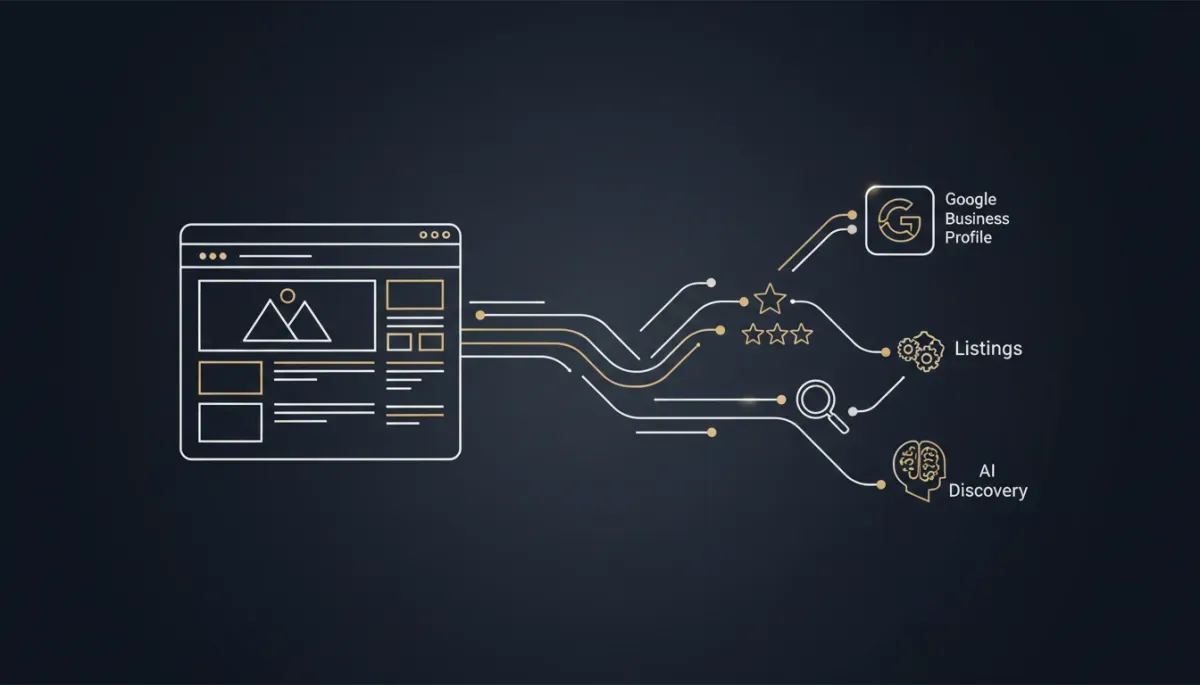
Traditional SEO vs. Modern Visibility for Local Businesses | GenM Online
Local Visibility, SEO, AI Search
Traditional SEO vs. Modern Visibility: What Really Gets Local Businesses Chosen Today
I’m Stoney Morris, Founder & Chief Strategist at GenM Online. For years, local and service-based businesses were told that “doing SEO” meant they would show up and win. Today, SEO is still essential—but it is only one part of a larger visibility and trust system that search engines and AI now rely on to recommend your business with confidence.
From “Being Optimized” to Being Trusted and Recommended
At its core, traditional SEO helps search engines understand your website. That is still non‑negotiable. You need a site that is crawlable, structured, and clear about what you do and where you do it. Modern visibility goes further—it helps search engines and AI systems trust your business enough to recommend you in search results, local maps, AI overviews, and other discovery experiences.
For small, local, and service-based businesses, this shift is critical. You are no longer competing only on keywords and backlinks—you are competing on identity, reputation, responsiveness, and clarity across the entire web.
Traditional SEO Foundations: Making Your Website Understandable
Traditional SEO focuses on your website as the primary asset. Done well, it ensures search engines can easily crawl, interpret, and index your pages. For local and service-based businesses, the key foundations include:
Website structure & crawlability — Clear navigation, logical page hierarchy, XML sitemaps, and no broken links so Google can efficiently discover your content.
Relevant page titles & descriptions — Concise, keyword-aligned titles and meta descriptions that signal each page’s topic and encourage clicks in search results.
Service and location pages — Dedicated pages for each service and service area (for example, “Emergency Plumbing in Austin”) so you can match local intent and “near me” queries in a clear, structured way.
Helpful, human-friendly content — Clear explanations of problems, solutions, pricing approaches, and processes—aligned with how people ask questions and how modern search and AI tools summarize information.
Internal linking — Thoughtful links between related services, FAQs, and locations that help both users and search engines navigate and understand relationships between topics.
Mobile performance & page speed — Fast, responsive pages that meet modern expectations for usability and load time, supporting both traditional search and AI‑driven experiences.
Technical SEO — Clean URLs, proper use of headings, canonical tags, and secure HTTPS to avoid confusion and indexing issues.
Schema markup & structured data — Marking up pages with schema types such as
LocalBusiness, services, FAQs, and reviews so search engines can interpret your content with greater precision.
These elements are the “table stakes.” Without them, it is difficult for Google to understand your website at all. With them, you have a solid foundation—but in 2026, they are not enough on their own to earn consistent visibility or trust in competitive local markets.
Modern Visibility: Expanding Beyond Your Website to a Connected Identity
Modern visibility recognizes that Google Search, Google Maps, AI overviews, and recommendation systems evaluate your business, not just your website. They look for consistent, trustworthy, and connected signals across the web. This is where many technically optimized sites fall short.
In addition to SEO foundations, modern visibility requires:
Complete Google Business Profile (GBP) — Verified, fully filled out with accurate categories, hours, services, photos, FAQs, and regular posts. Profiles that are incomplete or out of date can limit how often a business appears in relevant local searches.
Consistent business information — Your name, address, phone, and website (NAP) must match across your website, GBP, directories, and major listings. Inconsistencies can create confusion for both people and automated systems trying to confirm your details.
Accurate listings and citations — Presence on relevant directories, industry platforms, and local sites that confirm you are real, active, and located where you claim to be.
Customer reviews and responses — A steady flow of authentic reviews, plus timely, thoughtful responses that demonstrate you listen and act. This visible engagement can make it easier for people to feel confident choosing your business.
Clear business identity — Consistent branding, messaging, and positioning across your website, GBP, social profiles, and content so AI systems can confidently describe who you serve and what you do best.
Schema that connects entities — Structured data that not only marks up your website, but also connects your business to your GBP, social profiles, and review sources, creating a machine-readable “knowledge graph” of your brand.
Trust signals & responsiveness — Visible policies, guarantees, certifications where relevant, and fast responses to inquiries—whether they arrive via web forms, chat, or phone. Fast, reliable responses can improve the customer experience and strengthen the trust people form after discovering a business.
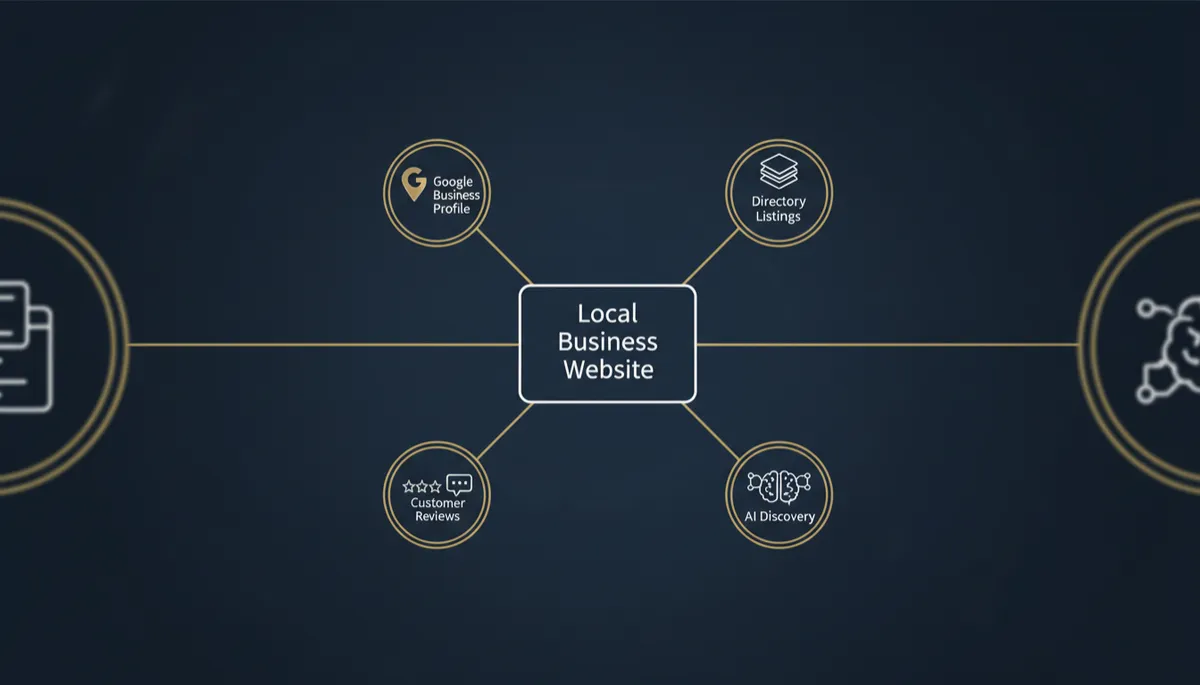
A connected visibility ecosystem links your website, profiles, reviews, and AI-ready signals.
How Different Systems Use These Signals: Search, Maps, and AI Answers
It is important to understand that no platform uses a single signal. Each blends website SEO, business data, and reputation in different ways—without guarantees of specific rankings or placements:
Google Search (organic results) leans heavily on website structure, content relevance, internal linking, technical health, and structured data—while also factoring in brand mentions and authority from across the web.
Local map results and the Local Pack can be influenced by factors such as relevance, distance, prominence, Google Business Profile information, reviews, and the consistency of your business details across the web.
AI-generated answers and recommendation experiences may use well-structured website content, clearly stated business information, and trusted external sources when forming an answer. The exact sources and signals vary by platform, query, and context.
Recommendation systems — AI assistants and other discovery systems may be more confident describing a business when its identity, services, location, and reputation are clearly and consistently represented across reliable sources.
None of these systems are “SEO only.” They are visibility and trust engines. To participate, your business needs both a solid website and a connected network of corroborating signals.
Side-by-Side: Traditional SEO vs. Modern Visibility Focus Areas
Traditional SEO Modern Visibility Webpages, keywords, on-page optimization, and technical structure. Business identity, reputation, trust, and relevance across platforms. Crawlability, metadata, headings, internal links, and sitemaps. Google Business Profile, listings, reviews, social presence, and responses. Schema on individual pages to clarify content types. Schema that connects your business, locations, profiles, and reviews into one ecosystem. Ranking individual pages for specific search queries. Being discovered, trusted, and recommended across search, maps, and AI experiences.
Why a “Perfect” Website Still Struggles: Real-World Scenarios
To make this practical, consider how this plays out across different types of local and service-based businesses.
Home services (plumbers, HVAC, electricians) — You might have fast pages, strong “service + city” content, and clean technical SEO. Yet, if your Google Business Profile is incomplete, your reviews are sparse, and your response times are slow, prospective customers may choose competitors whose business information, reputation, and signs of reliability are easier to verify.
Professional services (law firms, accountants, consultants) — Detailed service pages and thought-leadership articles help organic rankings. However, prospective clients often check reviews, profiles, and social proof before reaching out. Without a consistent business identity and visible testimonials across platforms, your technically strong site may still feel “unproven.”
Clinics and health practices — Medical and wellness searches are especially sensitive to trust. Even with excellent content and schema, missing or inconsistent listings, outdated hours, or unaddressed reviews can reduce confidence and make other providers appear easier to verify.
Coaches and advisors — Your site may clearly describe your programs and outcomes. But if your brand story, social presence, and reviews are fragmented, people and automated systems may have a harder time clearly understanding your specialty, location, and reputation.
Local operators (gyms, studios, salons, repair shops) — You could rank for some branded or generic terms, yet still be overlooked if your GBP photos are outdated, your hours are wrong, or there is little evidence of recent customer activity. An active, responsive, and consistent presence can make the business clearer and more trustworthy to prospective customers.
In each case, the issue is not that SEO “failed.” It is that SEO alone does not create the connected visibility and trust ecosystem modern search and AI systems are now built to evaluate.
Modern Visibility Builds on SEO, It Does Not Replace It
At GenM Online, we view traditional SEO as the structural foundation—your website’s architecture, content, and technical health. Modern visibility then connects that foundation to the rest of your digital footprint:
Your website communicates what you do, where you do it, and why it matters.
Your Google Business Profile and listings confirm that information in Google’s local ecosystem and beyond.
Your reviews and responses demonstrate that real customers choose you and are heard when they do.
Your schema markup helps search engines interpret the relationships among your business, website, services, locations, and profiles.
When these elements work together, you move from “we have an optimized site” to “we have a connected visibility and trust engine” that supports sustainable growth, not just short-term rankings.
How GenM Online’s Get Found — Visibility & Trust Engine Helps
GenM Online exists to simplify this complexity for local and service-based businesses.
Our Get Found — Visibility & Trust Engine is designed as a connected foundation that enhances the signals you already have—and fills the gaps that hold many businesses back.
Instead of treating SEO, reviews, listings, and communication as separate projects, the Visibility & Trust Engine helps you:
Align your website content and structure with your Google Business Profile, listings, and social profiles.
Strengthen and streamline your review collection and response workflows so trust signals stay current and visible.
Maintain consistent, accurate business information across platforms, which supports both local rankings and AI discovery.
Connect schema markup and business data so search engines can interpret one coherent business identity.
For many teams, this connected approach becomes the base layer that other GenM Online capabilities—such as our Growth Engine and GENM OS—can build on to support faster responses, better customer journeys, and smarter scaling. The focus remains the same: helping you get found, get chosen, and grow in a sustainable, systemized way.
Your Next Step: Evaluate the Whole System, Not Just Rankings
If you are investing in SEO but still wondering why leads are inconsistent or why AI tools rarely mention your business, it is time to zoom out. Look beyond individual keywords and positions, and ask:
Is our website structurally sound, clear, and helpful?
Is our Google Business Profile complete, current, and aligned with our site?
Are our listings, reviews, and social profiles telling a consistent, trustworthy story?
Can search engines and AI clearly see who we are, where we operate, and why customers choose us?
Modern visibility is not about chasing shortcuts or guarantees. It is about building a connected, trustworthy presence that works with how people—and AI systems—actually search, compare, and decide today.
If you want a clear, practical view of where you stand, start by assessing the entire visibility and trust system around your business, not just your website rankings.


