Speed to Lead: Fast Response Wins Local Customers | GenM Online
Lead Response, Local Marketing, Service Businesses
Speed to Lead: Why Fast Response Wins Local Customers Before Your Competitors Do
For small, local, and service-based businesses, the first few minutes after a new inquiry can strongly influence whether you win or lose the opportunity. Not because of your quality, reputation, or years in business—but simply because of how fast you respond.
Why Fast Lead Response Matters More Than Ever for Local Businesses
Many local businesses respond more slowly than customers now expect. When someone needs a plumber, clinic, attorney, coach, or other service provider, they often contact several businesses and move forward with the first one that responds clearly and professionally.
For local operators—plumbers, electricians, dentists, clinics, law firms, coaches, salons—that gap is where revenue leaks out. When someone searches “emergency plumber near me” or “physical therapist nearby,” they rarely contact just one provider. They tap to call, fill out a form, or send a message to two or three options and then go with whoever responds first with clarity and confidence.
Key Takeaway: In 2026, speed to lead is often more decisive than price, reviews, or years in business—because customers are impatient and options are one tap away.
How Slow Response Hands Your Leads to Faster Competitors
Slow response does not just “delay” revenue—it actively sends it to someone else. When your phone rings and goes unanswered, or a form submission sits in an inbox, here is what typically happens:
Calls: The caller hits voicemail, hangs up, and dials the next listing. If you do not follow up in minutes, that job is gone—even if your work is better and your reviews are stronger.
Form submissions: A web visitor fills out “Request a Quote” and expects a near-instant reply. If they do not hear from you quickly, they submit the same request to a competitor whose system responds first.
Website chat: When a chat bubble says “We typically reply in a few minutes” but nobody answers for hours, trust evaporates. That visitor closes the tab and books elsewhere.
Google Search and Maps leads, including calls, website clicks, bookings, text, or WhatsApp where available: Many high-intent leads now start directly from Google. A delayed response reduces the chance that the inquiry turns into a booked customer.
Facebook Messenger and social DMs: People often ask quick questions—pricing, availability, insurance, next openings. If your page shows “typically responds in a day,” and a competitor shows “typically responds in minutes,” most leads will not wait for you.
In local markets, that often means your competitor is capturing the conversation before you even see the notification.
Every Channel Matters: Phone, Text, Email, Chat, and Social
Customers no longer care which channel “belongs” to marketing, reception, or the owner. They just expect a fast, clear response wherever they reach out:
Phone: Missed calls must trigger instant follow-up, not a vague promise to “check voicemails later.”
Text: Many people prefer SMS for quick questions. A fast, friendly text reply feels personal and modern.
Email: Automated acknowledgments and clear next steps keep leads from wondering if you ever saw their message.
Website chat: Real-time or near-real-time chat support can convert undecided visitors into booked appointments on the spot.
Google Search and Maps leads: Fast replies here directly influence who gets chosen from the map pack and local search results.
Facebook Messenger and social DMs: These channels are often where urgent, high-intent questions show up after hours or on weekends.
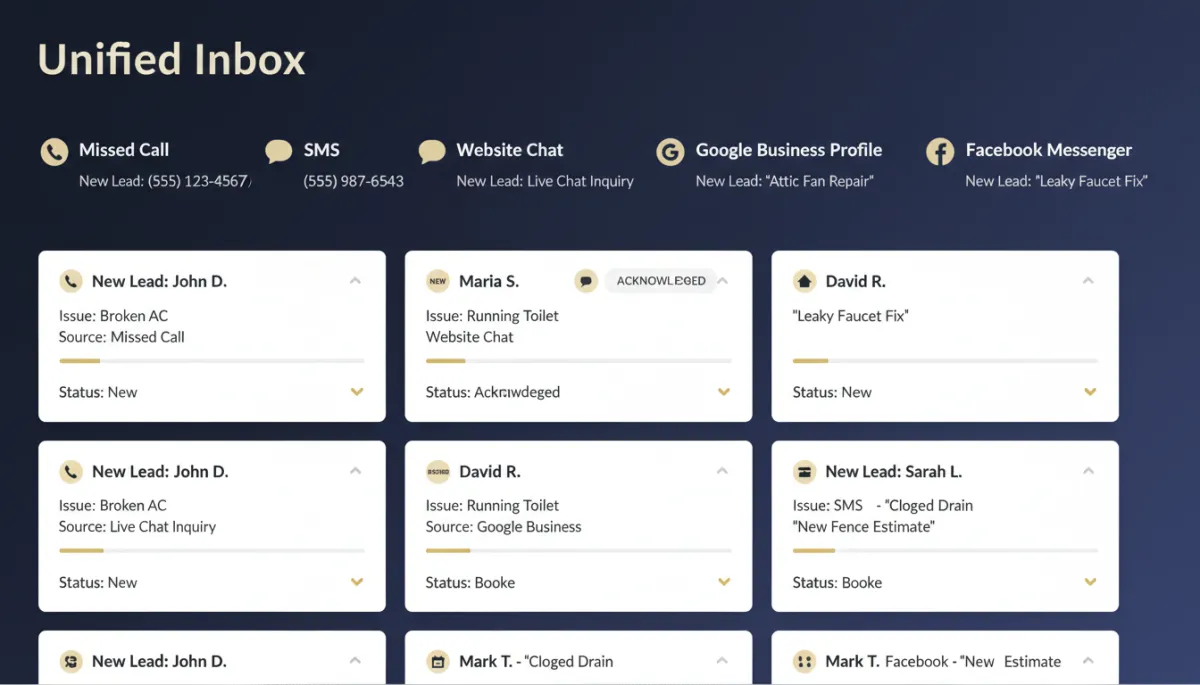
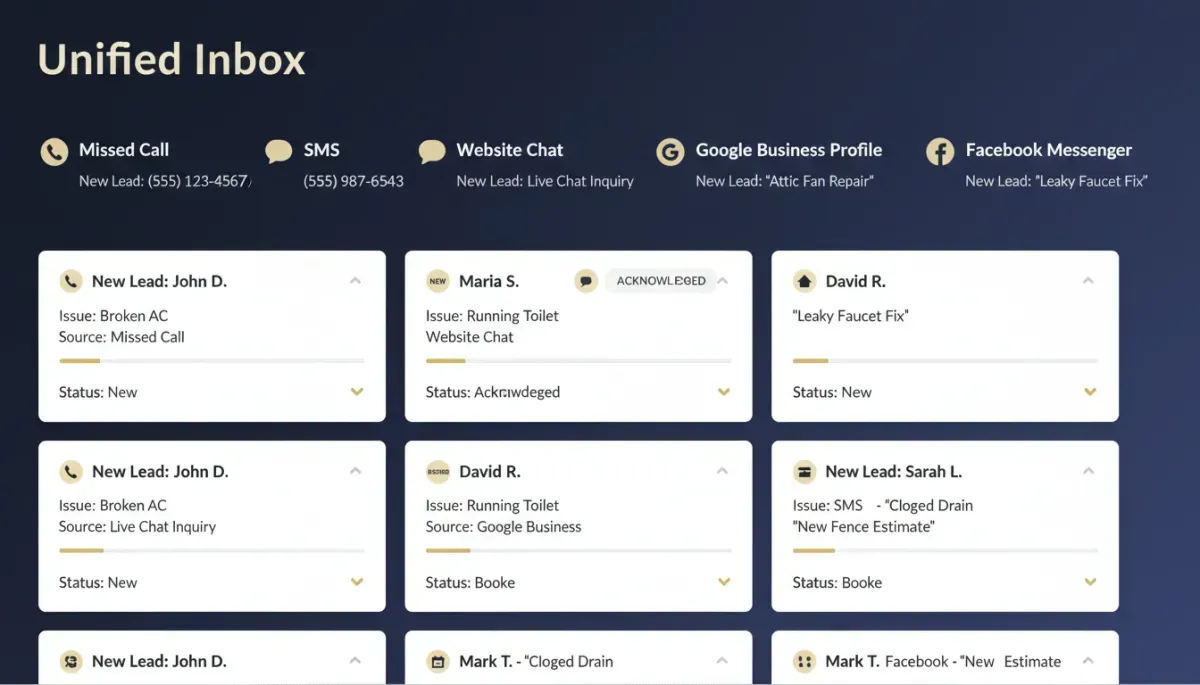
A single shared inbox turns scattered messages into one clear, fast-moving pipeline.
Practical Ways to Dramatically Improve Your Lead Response Speed
The good news: you do not need a call center to respond quickly. You need smart systems that handle the first touch automatically, then bring your team in when judgment and expertise are needed. Here are practical tools and workflows local businesses can use today.
1. Missed-Call Text Back
When you miss a call, an automatic text should go out within seconds: “Hi, this is GreenLeaf Plumbing. We just missed your call—how can we help?” This simple automation:
Confirms you received the inquiry.
Opens a text conversation you can continue between jobs.
Prevents the caller from immediately dialing the next business.
2. Automated Acknowledgments on Every Channel
Every form submission, email, chat, or social message should trigger an instant acknowledgment that:
Confirms you received their inquiry.
Sets expectations (“We’ll review this and respond within 15 minutes during business hours.”).
Asks for any missing basics (address, preferred time, issue description).
This alone moves you from “Did they get this?” to “I know they are on it,” which keeps prospects from shopping around.
3. Conversational AI That Moves the Lead Forward (Without Replacing People)
Responsible conversational AI can handle the first steps of the conversation across chat, text, and some social channels by:
Collecting basic information: name, contact details, location, service needed, timing, and budget range where appropriate.
Sharing simple, approved answers: office hours, services offered, insurance accepted, or how your process works.
Offering available appointment windows or consultation slots for the prospect to choose from.
Humans still handle pricing nuance, sensitive topics, diagnoses, and final decisions. Automation simply ensures nobody waits hours for a first reply.
4. Shared Inboxes and Smart Lead Routing
Instead of scattering messages across personal phones, email accounts, and social apps, a shared inbox pulls everything into one place. From there, lead routing can:
Assign home service leads by territory or trade (e.g., Northside plumbing vs. Southside HVAC).
Route clinic inquiries by service line (physical therapy vs. chiropractic vs. counseling).
Send professional service leads (legal, accounting, consulting) directly to the right practice area.
Pro Tip: Define clear ownership rules—who responds first, who backs them up, and what “done” looks like for every new lead.
5. Instant Booking, Reminders, and Follow-Up Workflows
The fastest way to win a lead is to move from “interested” to “booked” in a single interaction. Connected systems can:
Offer real-time appointment booking links via text, chat, or email.
Send automated reminders to reduce no-shows for clinics, coaches, and consultants.
Trigger follow-up sequences if someone asks for a quote but does not book right away.
Again, automation does the heavy lifting; your team steps in where expertise, empathy, and judgment matter most.
Real-World Examples: How Fast Response Plays Out by Industry
Home services: A homeowner discovers a leak at 9:00 p.m. They send messages to three plumbers via Google and Facebook. Only one has missed-call text back and chat automation running. Within two minutes, that business has acknowledged the issue, collected photos, confirmed the address, and scheduled a morning visit. The other two might respond the next day—but the job is already taken.
Professional services: A small business owner needs help with a contract review. She submits a form on three law firm sites. One firm sends an instant confirmation, offers a 15-minute discovery call slot, and follows up with a reminder. Another replies 24 hours later; the third never responds. The firm that responded first did not have the lowest rate—but it won the client by showing reliability from the first touch.
Clinics: A parent looks for a new pediatric dentist on Saturday. They message two clinics on Google. One clinic’s automation replies immediately, gathers basic details, and lets them request a Monday appointment time. The other waits until Monday afternoon to respond. By then, the family has already committed to the first clinic and is on the calendar.
Coaches and local instructors: A potential client DMs a fitness coach on Instagram asking about availability and pricing. The coach using a connected platform sends an instant, personalized acknowledgment, shares a link to book a free intro session, and follows up via SMS. Another coach sees a similar DM two days later and replies—only to find the prospect has already started a program elsewhere.
How Fast Response Builds Trust, Conversion, Reputation, and Visibility
Fast response is not just about capturing leads—it strengthens every part of your growth engine:
Trust: Quick, clear replies signal reliability. People assume you will show up on time and follow through if you respond promptly at the very beginning.
Conversion: Responding promptly increases the chance that you reach the customer before they commit to another provider.
Reputation: Fast, helpful communication leads to better experiences, which leads to better reviews—and more people choosing you from search results and maps.
Modern visibility: Fast, consistent engagement improves the customer experience and can strengthen the overall trust signals surrounding your business.
How GenM Online Connects Lead Capture, Conversation, Automation, and Growth
GenM Online was built specifically for local and service businesses that want to respond faster, build trust, and grow in a modern, sustainable way. Instead of stitching together separate tools, GenM Online brings your Visibility & Trust Engine™ into one connected platform:
Lead capture: Forms, website chat, Google Search and Maps leads, social DMs, and missed calls all flow into a single, organized system.
Conversations: A shared inbox lets your team see every message, respond quickly, and keep context across channels.
Automation: Missed-call text back, automated acknowledgments, and conversational AI confirm receipt, collect key details, and move leads forward 24/7—while keeping humans in control of judgment calls and sensitive topics.
Booking and reminders: Prospects can move from first contact to confirmed appointment in a single flow, with reminders reducing no-shows and confusion.
Reviews and follow-up: After the job, automated but human-sounding follow-up sequences help you request reviews, nurture repeat business, and stay top of mind.
The result is simple: you get found, you get chosen, and you respond faster—without burning out your team or relying on patchwork tools.
See Where You Stand: Start Your Free GenM Online Visibility Scan
If you are not sure how your current response times, visibility, and reputation compare to today’s expectations, you are not alone. Many established local businesses simply have not had the tools or visibility to measure this—until now.
The GenM Online Visibility Scan gives you a clear, practical snapshot of how easily customers can find you, how credible you appear, and where leads might be slipping through the cracks. From there, you can decide—on your terms—how to tighten your systems, respond faster, and convert more of the opportunities you are already earning.
If you are ready to stop losing leads to faster competitors—and start turning every call, click, and message into a confident, timely conversation—Start Your Free Visibility Scan with GenM Online today.


