SEO, AEO & GEO: What Small Businesses Need to Know
Local Marketing, SEO, Answer Engines, Generative Search
I’m Stoney Morris, Founder & Chief Strategist at GenM Online. Every week, I talk with local and service-based business owners who are asking the exact same questions: Is SEO dead? Has GEO replaced it? Do websites even matter now that everyone is using ChatGPT and Gemini? Let’s clear this up in plain language and focus on what actually matters for your business.
First, let’s debunk the noise: SEO is not dead, but search has changed
You’ve probably heard at least one of these:
“SEO is dead — AI answers everything now.”
“GEO replaced SEO — you only need to optimize for AI.”
“AI search changed everything — websites don’t matter anymore.”
Here’s the reality: SEO is not dead. What changed is where and how your business gets discovered. People still search, but the results are no longer just a list of blue links. Discovery now happens across:
Direct answers and AI summaries at the top of results (often called AI Overviews or answer boxes)
Conversational search in tools like ChatGPT, Gemini, and voice assistants
Maps, local packs, and business profiles (Google Business Profile, Apple Maps, etc.)
Recommendations pulled from reviews, directories, and trusted third-party sites
Key Takeaway: SEO didn’t disappear — it expanded. You’re no longer just optimizing for a list of links; you’re optimizing for answers, conversations, and context.
Clear definitions: SEO, AEO, and GEO in plain language
SEO — Search Engine Optimization (discoverability)
SEO is about making your website and online presence easy for search engines to find, understand, and index. It covers things like:
Pages that load quickly and work on mobile devices
Clear titles, headings, and meta descriptions that match what people search for
Internal links that show which pages are most important
Local signals like your Google Business Profile and consistent business details (name, address, phone)
In short, SEO is the foundation that helps search engines know your business exists and what you do.
AEO — Answer Engine Optimization (answer clarity)
AEO focuses on how your content appears when people ask questions — especially conversational or voice-style questions. It’s about structuring information so that search engines and AI tools can easily pull clear, direct answers from your pages.
Writing short, direct answers near the top of a page or section
Using FAQs that mirror the exact questions customers ask (“How much does HVAC repair cost in Rockville, MD?”)
Providing definitions, comparisons, and step-by-step explanations in simple language
AEO is about making your content the kind of clear, trustworthy answer that search engines and AI systems feel comfortable referencing.
GEO — Generative Engine Optimization (AI interpretation)
GEO is about how your business and content are understood by generative AI systems — the tools that write summaries, answer questions in chat, and combine information from many sources. GEO is still an emerging field, but at a practical level for small businesses it includes:
Keeping your business information consistent across your website, profiles, and directories so AI sees one clear “version” of you
Using structured data (schema) to label your services, location, reviews, and FAQs in a machine-readable way
Being present on multiple trusted platforms (your site, Google Business Profile, industry sites, local directories) so AI sees repeated, aligned signals
GEO doesn’t replace SEO or AEO. It builds on them to help AI systems interpret your business correctly when they create summaries and recommendations. As Wikipedia notes, generative engine optimization is about improving how generative systems reference and represent your content, not gaming them or forcing outcomes.
Important: No SEO, AEO, or GEO tactic can guarantee rankings, AI citations, or inclusion in summaries. These systems decide what to show based on many signals. Your job is to make your business clear, consistent, and genuinely helpful.
How SEO, AEO, and GEO actually work together
Think of SEO, AEO, and GEO as layers, not competing strategies:
SEO makes your pages and profiles discoverable.
AEO makes your content’s answers clear and usable in search and AI responses.
GEO helps generative systems interpret and reference your business correctly across conversations and summaries.
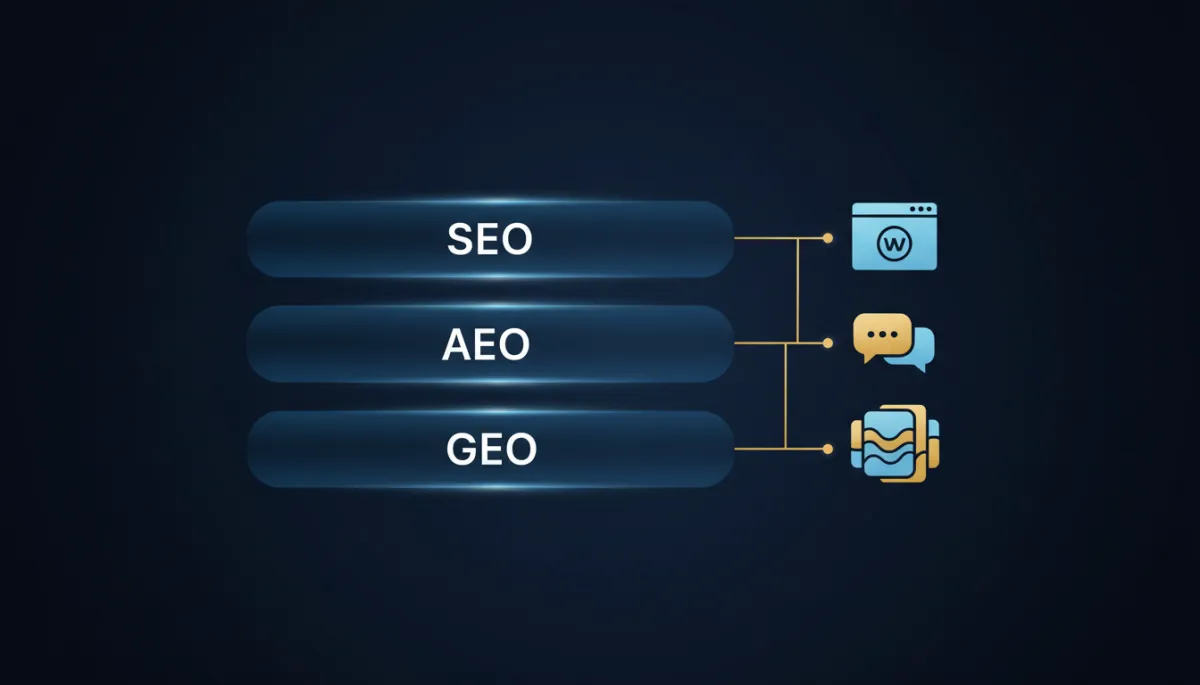
When SEO, AEO, and GEO align, your business is easier to find, trust, and reference.
Why small, local, and service-based businesses should care
If you run an HVAC company, dental clinic, law firm, or any local service business, here’s why this matters now more than ever:
Customers ask conversational questions. People type or speak questions like “Who can fix my AC tonight near me?” or “Best family dentist that takes my insurance.” AI and search engines try to answer those questions directly, often before a user clicks a website.
Search results may provide the answer before the visit. Studies from platforms like Ahrefs show AI Overviews and rich results can significantly reduce clicks to individual websites. That means your information has to be useful right inside those answer experiences, not just on your homepage.
Inconsistent business info confuses both people and systems. If your hours, phone number, or services differ across your website, Google Business Profile, and directories, it becomes harder for AI and search engines to confidently recommend you. Confusion often leads to invisibility.
Modern visibility is no longer just “rank #1 for a keyword.” It’s about being consistently present, clear, and trustworthy across all the places people look and all the systems that interpret your business.
Practical example: “HVAC repair Rockville MD” through SEO, AEO, and GEO
Traditional SEO view: “I need to rank for HVAC repair Rockville MD”
In the old model, you might:
Create a service page titled “HVAC Repair in Rockville, MD”
Add the keyword a few times in headings and text
Try to get a few backlinks from local sites
That’s still useful, but it’s only the SEO layer. It helps search engines know that you offer HVAC repair in Rockville and that your page is relevant for that phrase.
AEO layer: providing direct, helpful answers
To support AEO, that same page might include:
A short, direct answer near the top, such as: “We provide same-day HVAC repair in Rockville, MD for residential and light commercial systems, with 24/7 emergency support.”
A FAQ section answering: “How fast can you come out for HVAC repair in Rockville, MD?” “Do you charge a trip fee?” “Do you service both AC and heating systems?”
Clear headings like “Emergency HVAC Repair in Rockville, MD” and “What to Expect From Our Service Visit”
Now, when someone asks an AI or search engine a question, your page has ready-made answers that can be pulled into snippets, overviews, or chat responses.
GEO layer: consistent presence and machine-readable clarity
To support GEO, you’d make sure that:
Your website, Google Business Profile, Facebook page, and top directories all show the same business name, address, phone number, hours, and service area.
You use local business and service schema on your HVAC repair page to label your services, service area, and contact options in a structured format search engines and AI tools can easily parse.
Your reviews mention “HVAC repair in Rockville” naturally, reinforcing that association across multiple sites.
The result: when someone asks, “Who can repair my AC in Rockville, MD?” AI systems have multiple, consistent, structured signals pointing to your business as a relevant option — even though there’s never a guarantee you’ll be chosen for the answer.
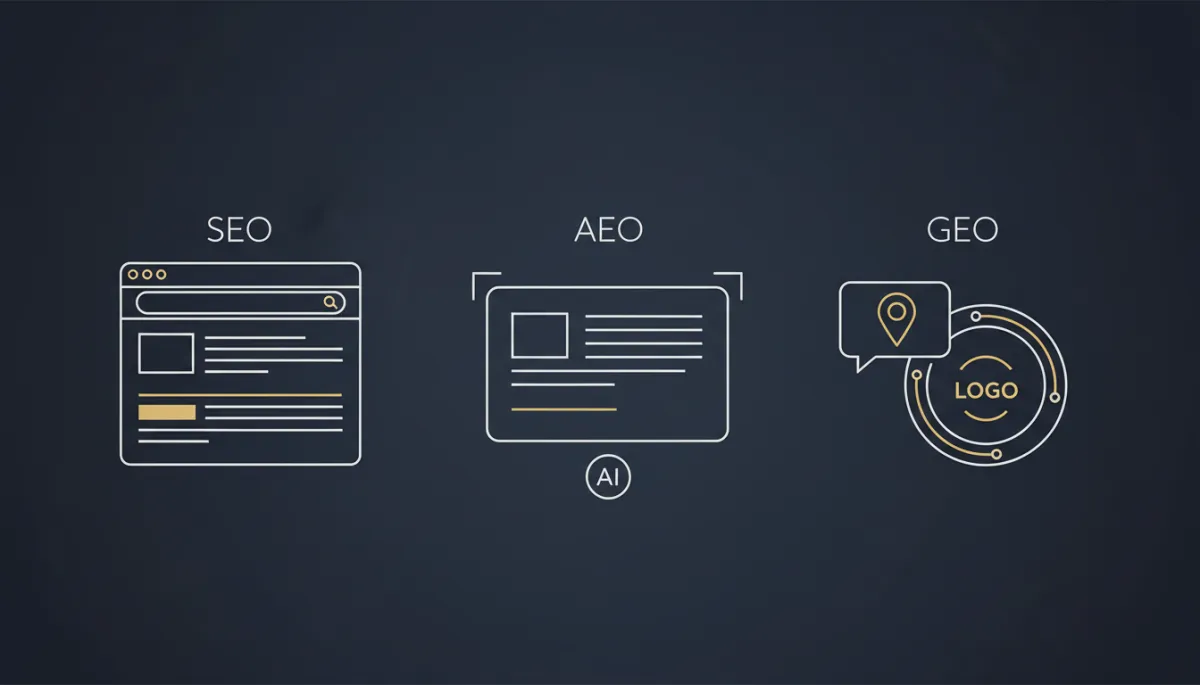
SEO targets visibility, AEO sharpens answers, and GEO clarifies your business in AI contexts.
What “cornerstone content” actually means for local businesses
“Cornerstone content” is one of the most misused phrases in marketing. It does not mean:
Every page must be 3,000+ words to rank
You need to publish multiple blog posts every week just to “feed the algorithm”
For a small or local service business, cornerstone content means a smaller set of well-maintained, accurate, and genuinely useful resources that anchor your expertise. Think of pages like:
Your main service pages (e.g., “HVAC Repair in Rockville, MD,” “Family Dentistry in Springfield”)
A clear “Service Areas” page mapping where you work and what you offer in each area
A “Pricing & What to Expect” or “New Patients” page that answers the most common pre-sale questions
One or two educational guides that explain a key topic in depth (for example, “Homeowner’s Guide to HVAC Maintenance in Maryland”)
A smaller, accurate library that you keep up to date is more valuable than dozens of thin, repetitive posts. This aligns with modern SEO guidance: in an era where AI can generate endless content, quality and clarity matter more than volume.
Pro Tip: Treat cornerstone pages like living documents. Review them regularly, update examples, refresh FAQs, and make sure every detail (pricing ranges, hours, services) is still accurate.
What makes content easier to understand and reference (for people and AI)
Whether we’re talking about SEO, AEO, or GEO, the same core principle applies: make it easy to understand and easy to trust. Here’s what that looks like in practice:
Clear, direct answers. Start key pages and sections with a short, plain-language answer before you dive into detail.
Accurate definitions. Explain industry terms in simple words. Don’t assume your reader knows jargon like “SEER rating” or “periodontal care.”
Descriptive headings. Use headings that say exactly what’s below them: “HVAC Repair Pricing in Rockville, MD” beats “More Information.”
Short paragraphs. Break up walls of text. Aim for 2–4 sentence paragraphs so readers — and AI — can scan and segment ideas easily.
FAQs. Add question-and-answer sections that mirror real customer language. This directly supports AEO and GEO because questions are a natural unit for AI to reference.
Comparisons. Simple comparison tables (e.g., “repair vs. replace,” “basic vs. premium service”) help both humans and systems understand your offerings quickly.
Original insights. Share your real-world perspective: what you recommend, what to watch out for, and how local conditions (climate, regulations, insurance) affect decisions. This is hard for generic AI content to replicate and can make your pages more valuable as a reference source.
Author identity. Include who wrote or reviewed the content (for example, you as the owner, or a licensed professional on your team). This supports trust and aligns with modern emphasis on expertise and accountability.
Update dates. Show when a page was last updated, especially for pricing, regulations, or medical/legal topics. Both people and systems look for freshness as a trust signal.
Internal links. Connect related pages (for example, your HVAC repair page linking to your maintenance guide and financing options). This helps search engines understand your site structure and helps users explore more deeply without getting lost.
Structured data (schema). Add schema markup for local business, services, FAQs, and reviews so that key details are available in a structured, machine-readable format. This supports SEO, AEO, and GEO simultaneously.
High-quality images. Use clear, relevant images with descriptive alt text (for accessibility) and captions that add context, not fluff. Avoid generic stock photos whenever possible; show your real team, equipment, or office when you can do so safely and appropriately.
Accessibility. Make sure text is readable, buttons are easy to click, and content works for people using assistive technologies. Accessibility improvements often overlap with good SEO and better user experience.

Strong cornerstone resources become reliable reference points for search engines, AI, and customers.
Simple comparison: SEO vs. AEO vs. GEO
Aspect SEO AEO GEO Main focus Make pages and profiles discoverable in search engines Provide clear, direct answers to user questions Help generative AI interpret and reference your business correctly Key optimization strategies Technical health, on-page keywords, local profiles, internal links FAQs, concise definitions, structured answers, descriptive headings Consistent business data, schema, multi-platform presence, entity clarity Typical outcomes Higher visibility in organic and local search results Increased use of your content in snippets and answer boxes Better alignment between how AI describes your business and reality
How this connects to GenM Online and the modern visibility stack
At GenM Online, we look at all of this through a simple lens: visibility and trust. Your website is still your home base, and SEO is still how search engines understand that home base. But modern visibility for local and service businesses now includes:
A solid website foundation that loads quickly, works on mobile, and clearly explains who you are, what you do, and where you work
An accurate, active Google Business Profile (and other key listings) with correct info, categories, photos, and posts
A steady flow of authentic reviews and responses that show you’re real, active, and attentive to customers
Schema and structured data that label your business, services, FAQs, and reviews in a way machines can easily understand
Helpful, focused content that answers the real questions your customers ask, in language they actually use
GenM Online’s Get Found — Visibility & Trust Engine™ is designed as that connected foundation for local and service businesses. It doesn’t promise rankings or AI placements — and it shouldn’t. Instead, it helps you:
Keep your business information consistent across profiles and directories
Collect, manage, and respond to reviews from one place, strengthening your trust signals
Build and maintain the kind of content and schema that supports SEO, AEO, and GEO together
That’s the core of what I care about as a strategist: not chasing hacks, but helping you build a business presence that people and systems can both verify and trust.
Your practical takeaway: don’t abandon SEO — modernize it
If you remember nothing else from this article, let it be this:
Do not abandon SEO. You still need a technically sound, clearly written website and consistent local profiles. That’s the base layer for everything else.
Lean into AEO. Structure your content around the questions your customers actually ask. Use FAQs, clear headings, and direct answers so your pages are easy to quote and summarize.
Support GEO with consistency and clarity. Keep your business data aligned across platforms, use schema where appropriate, and maintain a small, high-quality library of cornerstone resources that AI systems can rely on.
You can’t control where you’ll appear in every search result or AI summary — and no honest provider will guarantee that. What you can control is how clearly and consistently your business shows up wherever it’s found.
If you’d like a straightforward look at how your current visibility and trust signals are working together, you can start with a free checkup: Start Your Free Visibility Scan Here


