
Your Customer Conversations Should Be Connected | GenM Online
Customer Experience, Local Service Businesses, CRM, Connected Communication
Your Customer Conversations Should Be Connected
For local service businesses, every call, text, email, and website inquiry is a potential customer you can serve today and a relationship you can grow tomorrow. When those conversations are scattered across phones, inboxes, sticky notes, and separate apps, opportunities slip through the cracks. When they are connected in one place, you respond faster, follow up consistently, and make it easier for customers to say “yes.”
Why Connected Conversations Matter for Local Service Businesses
Service businesses live and grow through conversations. A homeowner calls about a repair. A patient sends a text to confirm an appointment. A business owner fills out your website form after hours. These touchpoints are not random; they are steps in a single relationship. When you connect those steps in one system, you gain a clear view of each customer and every opportunity in your pipeline.
Keeping customer calls, text messages, emails, website inquiries, lead records, and follow-up activities connected delivers practical benefits:
Faster responses: See new leads and messages in one place, instead of checking multiple apps and inboxes.
Better context: View full history before you pick up the phone, reply to a text, or send an estimate.
Consistent follow-up: Schedule reminders, automate touchpoints, and keep every lead moving forward.
Easier scheduling: Move from conversation to booked appointment without switching tools or losing details.
The Hidden Cost of Disconnected Communication Tools
Many local businesses grow into a patchwork of tools over time: a cell phone for calls and texts, a shared email inbox, a form on the website that sends leads to someone’s email, a spreadsheet for quotes, and a separate calendar for appointments. It feels manageable—until it is not. Disconnected tools create predictable problems that directly impact revenue and customer experience.
Lost Context and Repeated Questions
When conversations live in different places, your team often does not see the full story. A customer might submit a website inquiry, follow up with a text, and then call your office. If those touchpoints are not linked to a single record, you end up asking the same questions again: “What was your address?” “When did you reach out?” “What service were you looking for?” This repetition frustrates customers and makes your business feel less organized than it really is.
Delayed Responses and Missed Messages
If new leads arrive in multiple inboxes, it is easy to miss something. A form submission gets buried under other emails. A voicemail sits unheard on a desk phone. A Facebook message waits in a separate app. By the time someone notices, that potential customer may have already booked with a competitor who responded first. In a service market where speed and reliability matter, disconnected tools slow you down.
Forgotten Follow-Ups and Lost Booking Opportunities
Most customers do not book on the first contact. They ask for an estimate, talk to a spouse, compare options, or wait for the right time. Without a connected system to track lead status and schedule follow-ups, those warm opportunities cool off. Notes get misplaced, reminders are never set, and no one owns the next step. The result is simple: fewer appointments on the calendar and more marketing dollars wasted on leads that never convert.
How a Connected CRM and Unified Conversation History Changes the Game
A connected CRM designed for service businesses pulls your customer communication into one organized view. Calls, texts, emails, website inquiries, and follow-up tasks are all tied to a single contact record and a clear timeline. Instead of jumping between apps, your team works from one source of truth.
Practical Example: Home Services Contractor
Imagine a plumbing company that receives a website inquiry at 9:00 p.m. The lead fills out a form asking for next-day service. With a connected CRM:
The inquiry automatically creates a new contact with name, address, and service request.
An automated text confirms receipt and offers a link to available time slots.
When the office opens, staff see the full history—form details, automated text, and any replies—in one timeline and can confirm the appointment with a single call or message.
No one has to dig through emails or ask the customer to repeat information. The conversation moves smoothly from inquiry to booked job.
Practical Example: Local Clinic or Wellness Practice
Consider a local clinic that handles appointment requests by phone, email, and online forms. With a unified conversation history:
Staff can see when a patient last visited, how they prefer to be contacted, and any open questions before reaching out.
Automated reminders reduce no-shows and free up time for care instead of manual outreach.
Follow-up messages after appointments are consistent, timely, and documented in the same record.
Patients feel remembered and respected, and the front desk team works with less stress and fewer manual steps.
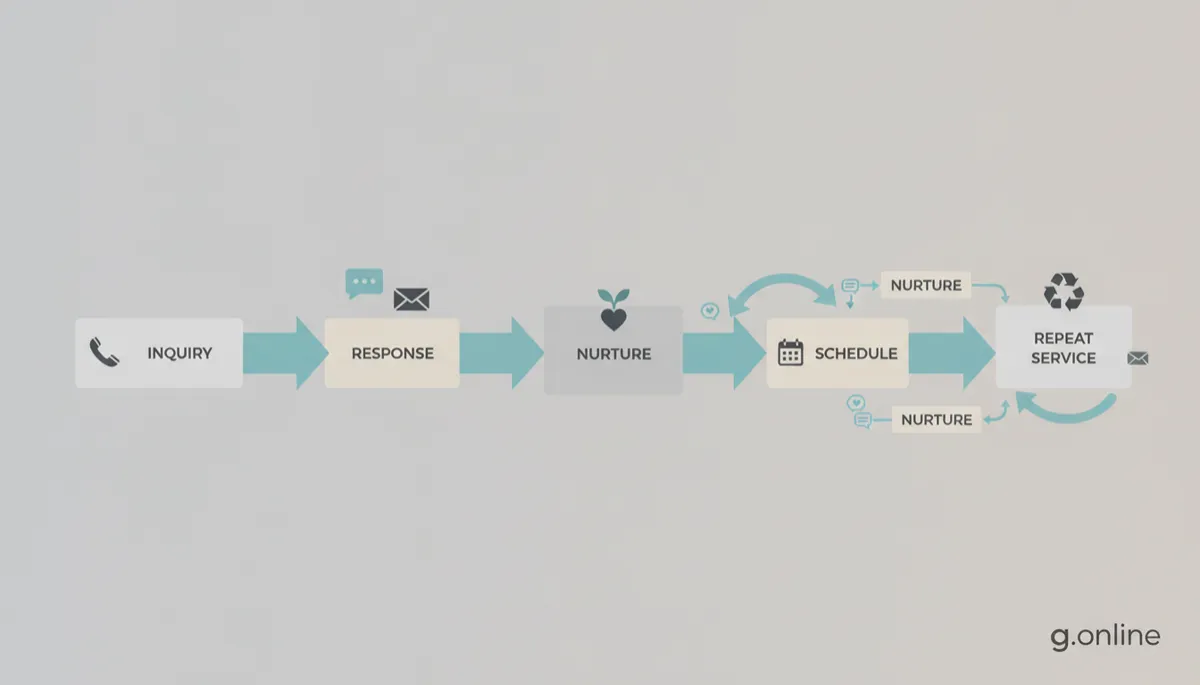
A connected journey turns every inquiry into a clear next step toward booking.
Supporting Lead Management, Follow-Up, and Scheduling in One System
When your CRM is connected to your communication channels and scheduling tools, lead management becomes more organized and predictable. Each new lead is captured automatically, assigned a status, and placed into a simple workflow. Your team always knows who needs a call, who is waiting on an estimate, and who is ready to book.
From First Contact to Confirmed Appointment
A connected platform lets you move seamlessly from conversation to calendar:
Capture leads from forms, calls, and messages directly into the CRM with no manual re-entry.
Offer available time slots via text or email from the same screen where you see the conversation history.
Automatically send confirmations and reminders once the appointment is booked, with all communication stored in the customer record.
This connected approach reduces back-and-forth, prevents double-booking, and gives customers a smoother experience from the first inquiry through service completion.
Checklist: Evaluate Your Customer Communication Systems
Use this practical checklist to assess how connected your current systems really are. For each question, answer “Yes,” “Partially,” or “No.”
Capture and Visibility
Do all new leads from your website, calls, and messages automatically create or update a contact record?
Can your team see every active lead and their status in one place without using spreadsheets?
Conversation History and Context
Before responding, can you easily see past calls, texts, emails, and notes for that customer in a single timeline?
Can multiple team members step into a conversation without asking the customer to repeat details?
Follow-Up and Automation
Do you have clear stages for leads (new, contacted, estimate sent, booked, lost) and automated reminders to follow up?
Can you send personalized but automated messages after quotes, appointments, and completed jobs?
Scheduling and Customer Experience
Can customers move from conversation to scheduled appointment without calling a second time or repeating information?
Are confirmations, reminders, and follow-ups all connected to the same record and visible to your team?
Pro Tip: If you answered “Partially” or “No” to several questions, there is likely revenue and customer trust locked inside disconnected tools. A connected platform can help you unlock both.
How GenM Online’s Growth Engine Connects Communication, CRM, and Scheduling
GenM Online is built for local and service-based businesses that want simpler, more connected systems. The Growth Engine brings customer communication, CRM, lead management, scheduling, and automation together so your team can focus on serving customers instead of managing software.
Unified inbox and CRM: View calls, texts, emails, and website inquiries in one place, tied to complete customer records and conversation history.
Organized lead management: Track every opportunity from first contact to booked job, with clear stages and next steps.
Connected scheduling: Offer time slots, confirm appointments, and send reminders without leaving the platform, keeping your calendar and communication aligned.
Practical automation: Use responsible, customer-friendly automation to handle confirmations, reminders, and follow-ups while maintaining a human tone.
Because GenM Online also supports visibility and reputation management, your communication system is not isolated. It is connected to how customers find you, read your reviews, and decide to reach out in the first place. That alignment helps your business get found, get chosen, and scale in a way that feels organized and sustainable.
Frequently Asked Questions
1. Do I need to replace all my tools to get connected conversations?
Not necessarily. The key is to centralize communication and customer history. Platforms like GenM Online’s Growth Engine are designed to connect core channels—calls, texts, emails, and forms—so you work from one source of truth, even if you keep some existing tools in place during the transition.
2. Is a connected CRM only useful for larger teams?
Connected conversations are often even more valuable for small teams. When the owner, office manager, and field staff can all see the same information, you reduce miscommunication, save time, and avoid relying on one person’s memory or personal phone for critical customer details.
3. How quickly can we see benefits from connecting our customer conversations?
Many service businesses notice practical improvements as soon as new leads start flowing into a unified inbox and CRM: fewer missed messages, clearer follow-up, and easier scheduling. Over time, the full history you build for each customer supports stronger relationships, more repeat business, and more confident decision-making.
Turn Scattered Conversations into a Connected Growth Engine
Your customers already expect fast, clear, and consistent communication. By connecting calls, texts, emails, website inquiries, lead records, and follow-up activities in one platform, you make it easier for your team to deliver that experience every day. Instead of chasing information, you can focus on what matters most: serving customers well and building a reputation that brings in the next opportunity.
If you are ready to see how connected systems could work for your business, explore GenM Online Solutions at https://genm.online/solutions. Get Found. Get Chosen. Scale Smarter.


